T

The Best In Ham Radio
Find Great Ham Radio Products
Sign Up Here For Your
Free Newsletter
No Spam -- EVER!
Special Pricing and Closeouts, New Products, Ham Radio News and Views, Technical Tips, and More. No spam --EVER! We will not share your information, and you can easily opt out at any time.
Free Shipping Now In Effect!
US Orders over $100 Ship Free
On-line Orders Only
You Will Pass Your Test!
Tips and tricks to pass your FCC Amateur Radio Exam.
Disclaimer:
Some will complain that my approach does not teach anything – that its only purpose lies in memorizing answers in order to pass the test. My answer is “you are 100% correct”. My experience has shown that sometimes our best and most enthusiastic operators – those who give back to the hobby – may not know which end of the soldering iron to hold. And conversely, some of the most technically adept Hams are notably hard to find when there is work to be done or Public Service events to staff. Most Hams, I think fall somewhere in between these extremes. A good friend of mine likes to say that there are 28 different kinds of Ham Radio, and that there’s something there for just about anybody. My goal here is to make (or upgrade) more Hams so that they can find out what kinds of Radio they’re going to enjoy. And if you follow my suggestions, YOU WILL PASS!! So here we go:
1. First and foremost, take the on-line practice tests. I can’t stress this enough. Try to do at least one or two a day. Don’t get discouraged by low scores when you’re starting out. Keep at it and very quickly you’ll see your scores improve as you remember the correct answers. There are several sites offering free practice exams, as well as a few offering paid versions. I’m not going to recommend one approach over another… I’ll leave it to your judgment as to which is best for you.
2. The Technician and General tests have 35 questions, and the Extra has 50. You need a score of 74% to pass. That’s 26 correct on the Tech and General, and 37 on the Extra. But! That also means that you can get 9 wrong and still pass Tech and General, or 13 wrong on the Extra. That’s a key concept, and here’s why: The test question pools are arranged in “groups” of questions on related topics. In all cases, there will only be one question from each group on your exam. So if there is a topic that you just can’t grasp, put that in your pile of 9 or 13 allowed wrong answers and concentrate on areas where you are stronger. Of course, when you come to that question on your exam, take a guess. There are no penalties for wrong answers, so it’s worth taking a shot.
3. Buy the appropriate ARRL License Manual. Sometimes a written explanation of a topic will clear up confusion and help you to understand it. But keep in mind that our goal here is to Pass That Test... so again, if a particular topic is giving you trouble, don't spend too much time on it. Go on to areas that you'll do better in.
4. For the Extra test, in particular, there are a lot of formulas, diagrams, and math involved. Concentrate on a few of the formulas that you can remember. As noted above, there will only be one question from each group, so if a particular equation gives you trouble, skip it and move on.
5. Download the entire question pool for your exam from the NCVEC Web Site. Make sure to get it as a Microsoft Word Document, or plain text (NOT a pdf). The correct answer is given in parentheses -- in the example below, it is (C). Now delete all of the wrong answers, and you are left with just the question and correct answer, as shown. Sort of like the flashcards you used in Grammar School, eh? Print out a copy, or two or three, and just keep re-reading them whenever you have a few spare minutes.
E5B06 (C)
How long does it take for an initial charge of 800 V DC to decrease to 294 V DC in a 450-microfarad capacitor when a 1-megohm resistor is connected across it?
A. 4.50 seconds
B. 9 seconds
C. 450 seconds
D. 900 seconds
So all you should see is:
How long does it take for an initial charge of 800 V DC to decrease to 294 V DC in a 450-microfarad capacitor when a 1-megohm resistor is connected across it?
450 seconds
6. The questions and answers on your test will be worded exactly the same as they are in the question pools, in the books, and in the on-line tests, although they may not be in the same order. If you can, try to remember a key phrase or number from the correct answer, especially in areas that you're less confident with. Make sure NOT to remember that "the answer to this question is (C)." Almost equally important is to try to remember key words that are INCORRECT. Here’s a good example from the Extra test:
E7H01
What are three major oscillator circuits often used in Amateur Radio equipment?
A. Taft, Pierce and negative feedback
B. Pierce, Fenner and Beane
C. Taft, Hartley and Pierce
D. Colpitts, Hartley and Pierce
First thing to remember – the answer to this one has three names. That rules out (A)
Second thing – Merrill, Lynch, Pierce, Fenner and Beane, Inc. was a corporate predecessor to Merrill, Lynch, Inc. They were stockbrokers, not engineers or inventors. That rules out (B).
Third Thing – Only one of them had the same name as a US President. William Howard Taft and Franklin Pierce both occupied the White House, so it can't be (C). The only remaining choice is (D). Or you could just remember that Colpitts is the unique choice, so it must be (D).
7. Answer every question on your test. Start by answering the questions you know for certain. Go through again, and answer the ones you're reasonably sure of. If there are still a few that you just don't know, take an educated guess. In many cases, you can eliminate one or two of the choices as obviously wrong. That will greatly increase your odds of a correct guess. Again, there is no penalty for a wrong answer. Finally, go through the test once more and make certain that every question is answered, and that you filled in the answer that you intended to.
8. Don't overthink your answers. If you're not sure, go with your first guess -- it's most likely to be correct.
9. Get a good night’s sleep before your exam. Don’t stay up all night cramming. Tiredness leads to careless mistakes. And for goodness sakes, relax! It’s a hobby, for the most part. Your job and future do not depend on it. In the very unlikely event that you don’t pass, even after using these tips, there will be another test session. But if you’ve prepared, YOU WILL PASS!!
10. OK, we’ve covered some general tips for studying. Some very informal, unscientific research leads me to believe that most of those who do not pass (especially Tech and General) only miss by a few questions. Further, I think it’s most often the technical questions that are missed. So here are a few simple things to remember that might just get you over the top.
11. Wavelength times Frequency = 300. 300 divided by Wavelength = Frequency. 300 divided by Frequency = Wavelength. Make sure to bring some blank note paper with you to your test. As soon as your test begins, write this down: “Wavelength x Frequency = 300”. Now in fact, it’s more accurately “Wavelength in Meters times Frequency in Megahertz = approximately 300”. But for simplicity, we round off. So, for example, we consider a signal on 146.00 MHz to be in the Two-Meter band – 2 times 146 = 292. Close enough to 300. Here’s a good example from the Technician test:
T1B03
Which frequency is within the 6 meter band?
A. 49.00 MHz
B. 52.525 MHz
C. 28.50 MHz
D. 222.15 MHz
OK, 300 divided by 6 = 50. So (C) and (D) are obviously wrong. Now instead of a 25% chance at a correct guess, you have a 50% shot. And if you can remember that the 6 Meter band starts at 50 MHz, then you know the answer has to be (B).
Here's another, with a little twist:
T1B05
Which 70 cm frequency is authorized to a Technician Class license holder operating in ITU Region 2?
A. 53.350 MHz
B. 146.520 MHz
C. 443.350 MHz
D. 222.520 MHz
300 divided by 70 = 4.28. Not even close to any of the choices. Except the question asked about the 70 CM band. That’s .7 meters. 300 divided by .7 = 428. Clearly, (C) is the correct choice.
One more, this one from the General Test:
G9B10
What is the approximate length for a 1/2-wave dipole antenna cut for 14.250 MHz?
A. 8 feet
B. 16 feet
C. 24 feet
D. 32 feet
So -- 300 divided by frequency in MHz = wavelength in Meters. 300/14.250 = approximately 21 Meters. A Meter is about 3 feet, so the wavelength is about 63 feet. But the question asks about a 1/2 wave antenna. Half of 63 is 31.5 -- and the only close answer is (D).
Again -- write down "Wavelength x Frequency = 300" as soon as your test begins.
12. Then immediately draw these two circles on your page.
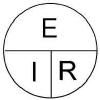
Ohm's Law states that Voltage (E) = Current (I) times Resistance (R); or E = I x R. We measure Voltage in Volts, Current in Amperes (or Amps), and Resistance in Ohms
Rearranging:
E = IR, I = E/R, and R = E/I
If you know any two, you can calculate the third. Using the chart above, cover the value that you're looking for and its formula appears. For example, if you need to find resistance, cover the R and you see E/I.
To remember which goes where on the chart, think (E)verything (I)s (R)elative.
To remember which letter goes with which value:
Resistance starts with "R"
Voltage ends in "E"
So Current must be "I"
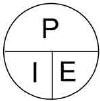
Power (P) is measured in Watts, and is equal to Current (I) in Amps times Voltage (E) in Volts.
Rearranging:
P = IE, I = P/E, and E = P/I
Just like the Ohm's Law chart on the left, cover the value you are looking for to see the formula. If you need to find Voltage, cover the I and you see P/E.
To remember which goes where on the chart, think "this stuff is as easy as PIE"
To remember which letter goes with which value:
Power (P) is measured in Watts and is the only one of the terms with a "w" in it.
Voltage ends in "E"
So Current must be "I"
If you use the hints above, you've now moved 3 or 4 questions from your "wrong pile" into the "I know this one pile". Along with everything else mentioned here, that will be enough for you to pass that test.
13. Look for patterns within groups of questions. Here are 5 questions from the Extra test. Can you spot the pattern?
E5B07 (C)
What is the phase angle between the voltage across and the current through a series R-L-C circuit if XC is 500 ohms, R is 1 kilohm, and XL is 250 ohms?
A. 68.2 degrees with the voltage leading the current
B. 14.0 degrees with the voltage leading the current
C. 14.0 degrees with the voltage lagging the current
D. 68.2 degrees with the voltage lagging the current
E5B08 (A)
What is the phase angle between the voltage across and the current through a series R-L-C circuit if XC is 100 ohms, R is 100 ohms, and XL is 75 ohms?
A. 14 degrees with the voltage lagging the current
B. 14 degrees with the voltage leading the current
C. 76 degrees with the voltage leading the current
D. 76 degrees with the voltage lagging the current
E5B11 (B)
What is the phase angle between the voltage across and the current through a series RLC circuit if XC is 25 ohms, R is 100 ohms, and XL is 50 ohms?
A. 14 degrees with the voltage lagging the current
B. 14 degrees with the voltage leading the current
C. 76 degrees with the voltage lagging the current
D. 76 degrees with the voltage leading the current
E5B12 (C)
What is the phase angle between the voltage across and the current through a series RLC circuit if XC is 75 ohms, R is 100 ohms, and XL is 50 ohms?
A. 76 degrees with the voltage lagging the current
B. 14 degrees with the voltage leading the current
C. 14 degrees with the voltage lagging the current
D. 76 degrees with the voltage leading the current
E5B13 (D)
What is the phase angle between the voltage across and the current through a series RLC circuit if XC is 250 ohms, R is 1 kilohm, and XL is 500 ohms?
A. 81.47 degrees with the voltage lagging the current
B. 81.47 degrees with the voltage leading the current
C. 14.04 degrees with the voltage lagging the current
D. 14.04 degrees with the voltage leading the current
If you noticed that the first part of every correct answer was 14 degrees, take a bow. Just as we saw earlier, your chance of a correct guess is now 50% instead of 25%. But it gets even better. And for that, we turn to our old friend Eli the Ice Man.
Huh?
Let's write it this way -- ELI the ICE man.
We already know that (E) is voltage and (I) is current. Similarly, (L) is inductance and (C) is capacitance. In an Inductor, the the voltage leads the current (or the current lags the voltage) -- hence, ELI. And in a capacitor, the current leads the voltage (or the voltage lags the current) -- hence ICE.
The last question in the series presents a circuit where XC is 250 ohms, R is 1 kilohm, and XL is 500 ohms. Since XL is greater than XC, the circuit overall is more inductive. And so we use ELI -- the voltage (E) is ahead of the current. And Voila! You may not know, or care, about phase angles, but you'll get that question right if it's on your test.
14. That's it, folks. Here are the top ten things to do:
(A) Take those on-line practice tests -- I firmly believe it's the best preparation you can do.
(B) Don't stress over areas that you just can't get. Whether you pass with 74% or 100%, you pass.
(C) Buy, and read, the License Manual for your test.
(D) Commit a few key formulas to memory.
(E) Download the question pool, delete the wrong answers, and print out your "flashcards".
(F) Make sure to answer every question. If you have to guess, go with your first choice.
(G) Write down the wavelength formula and Ohm's law charts as soon as the test starts.
(H) Look for patterns in the answers.
(I) Take those on-line practice tests.
(J) And finally -- TAKE THOSE ON-LINE PRACTICE TESTS!!!
I hope that you will find these tips 'n' tricks helpful. I know that if you use them, and if you put in the necessary effort, YOU WILL PASS YOUR TEST.
I welcome additions and corrections. If you have a tip or trick, please e-mail it to jbee@qsradio.com
This page, and the entire Web Site, is Copyright © 2002-2026 by Quicksilver Radio Products. You are welcome to link to it, but please do not copy and paste to another site.
Finally, best of luck in passing your test. I hope to hear you on the air using your new privileges.
Thanks and 73,
John Bee, N1GNV
In memory of John B Thank You for Visiting Quicksilver Radio Today!
This entire site and its contents Copyright © Quicksilver Radio Products 2002-2026